Every October, pumpkins find their way into preschool classrooms.
We count them, paint them, carve them, and turn them into all kinds of seasonal activities.
But what happens when we stop treating the pumpkin as a decoration and start treating it as something to investigate?
A pumpkin offers a surprisingly rich opportunity for young children to practice the habits of scientists: looking closely, noticing differences, describing what they observe, asking questions, and sharing discoveries.
And it doesn’t take an elaborate science laboratory. A pumpkin, a few clear containers, some picture-supported vocabulary cards, and a place for children to record what they notice can transform an ordinary classroom table into a science investigation.
Start with the real thing
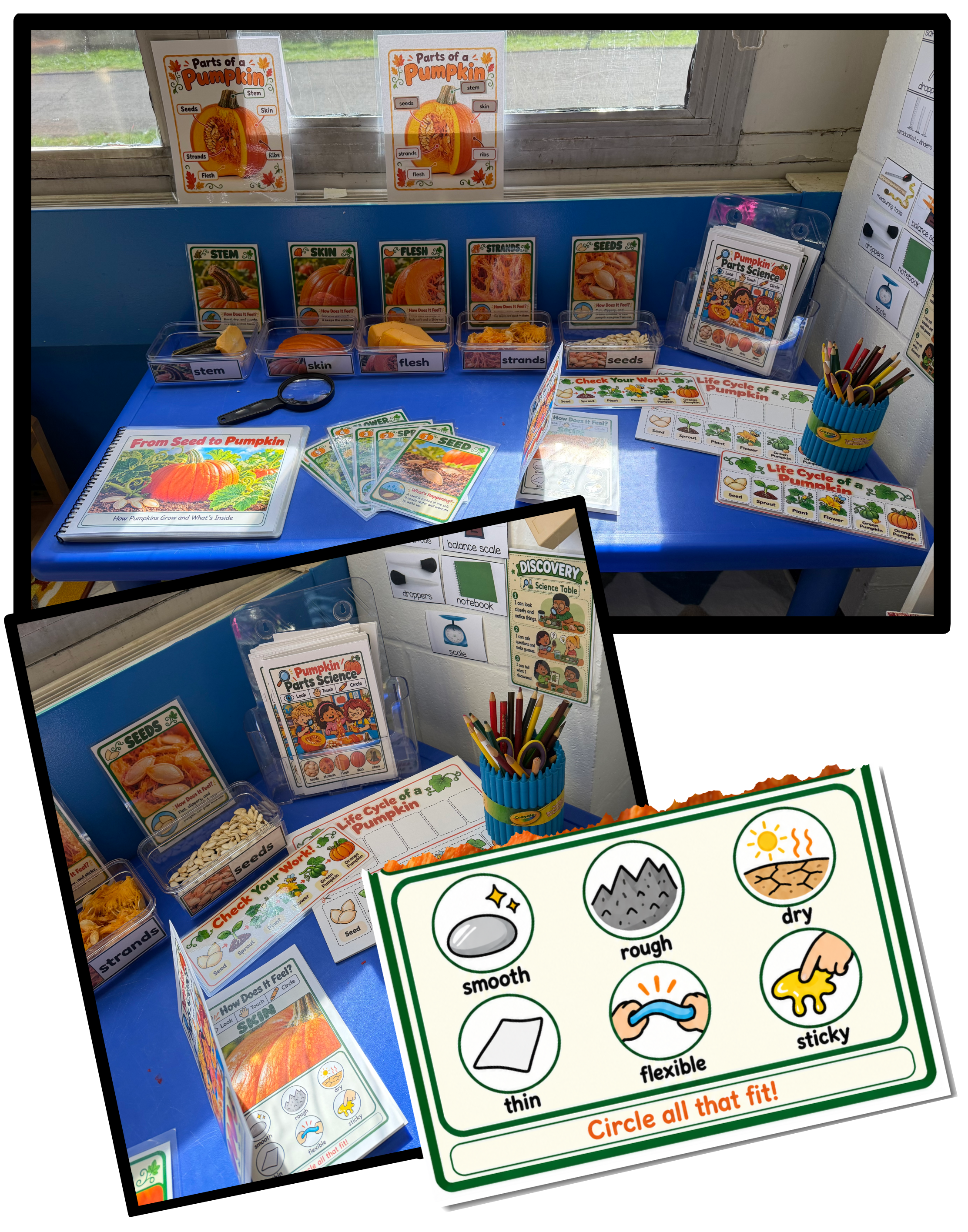
At our preschool science table, children can explore five parts of a pumpkin: the stem, skin, flesh, strands, and seeds. (Ribs, the bumpy lines running down the outside, get their own close-up card and a spot in our conversations.)
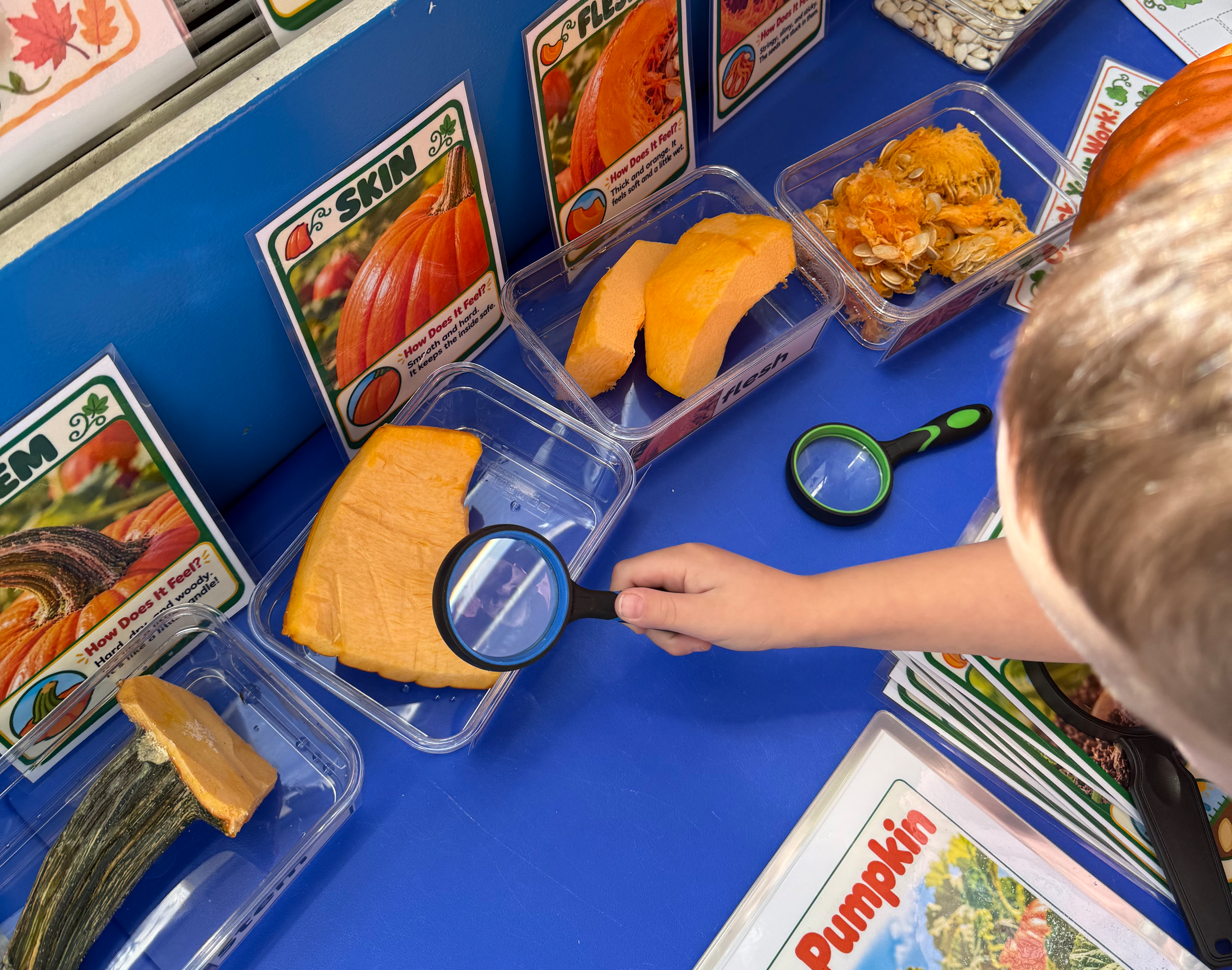
Each part is placed in a labeled container beside a photographic reference card. Children are invited to look closely, touch when they’re comfortable, and think about what makes each part different. Hands-on exploration is one of the things that makes this center so much fun so have plenty of wipes near by.
Is the stem hard or soft?
Does the skin feel smooth?
Are the strands wet, sticky, or stringy?
The goal isn’t for every child to choose the same answer. It’s for children to notice, describe, and explain what they observe.
And because the investigation uses picture-supported attribute choices, children don’t have to be able to read or write to participate meaningfully.
They’re doing science before they can spell science.
What Are They Learning?
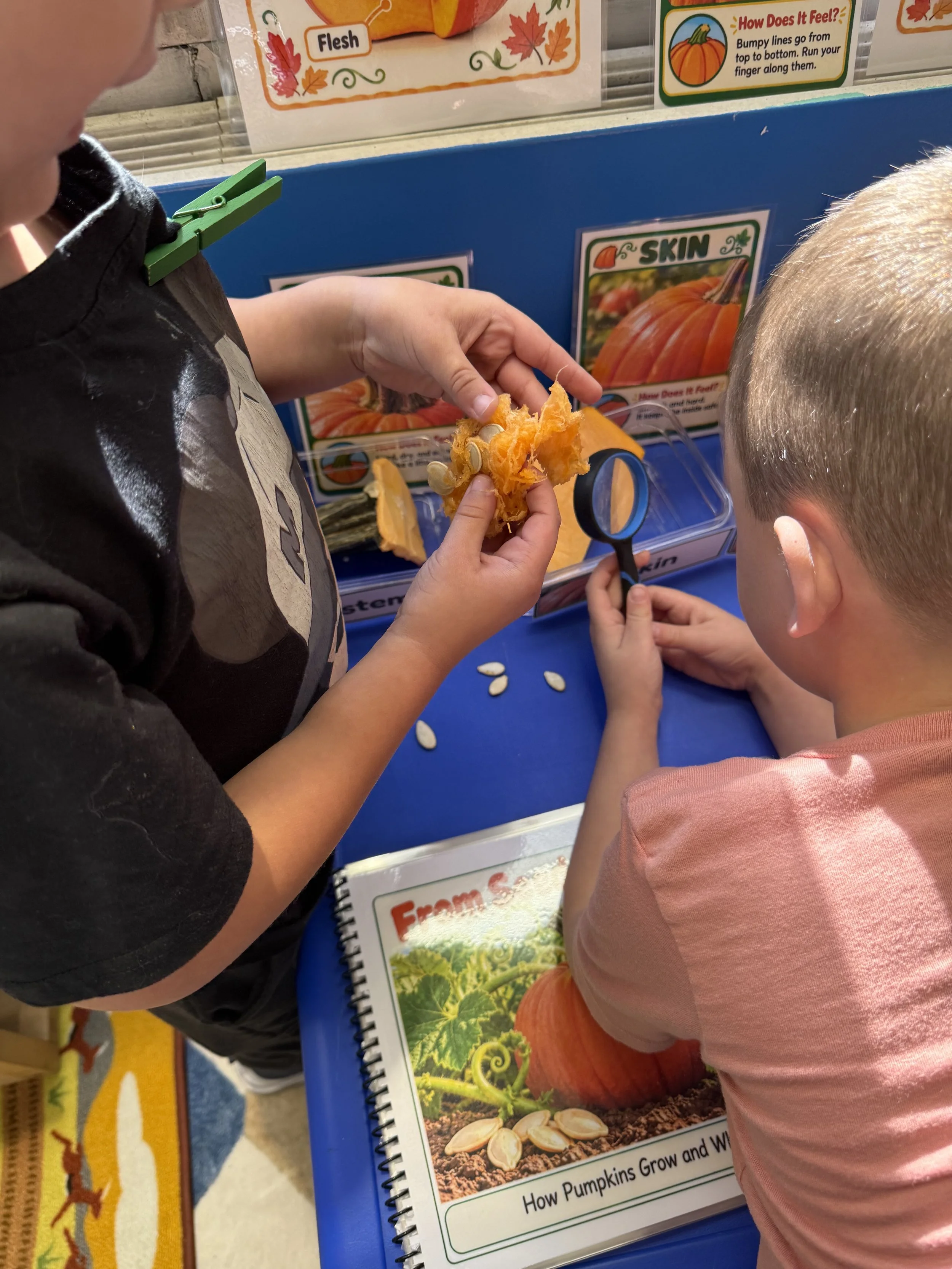
It might look like two children playing with pumpkin guts. But there's quite a bit more happening.
They're examining an unfamiliar texture, looking closely at details, and exploring how the strands and seeds fit together. They're also sharing materials and discoveries.
These are the beginnings of scientific thinking. Children don't need to know words like observation or investigation to practice the skills behind them.
And sometimes the most productive thing an adult can do is resist the urge to explain everything and simply ask, “What do you notice?”
Zooming out to the life cycle
Once children know the parts, a bigger question follows: where did this pumpkin come from? We start with a life cycle poster showing six stages: seed, sprout, plant, flower, green pumpkin, and orange pumpkin. Children then arrange six photo cards on a sequencing board. A frequently asked question is, “What makes you think the flower comes before the green pumpkin?” The task is reasoning, not memorizing card numbers.
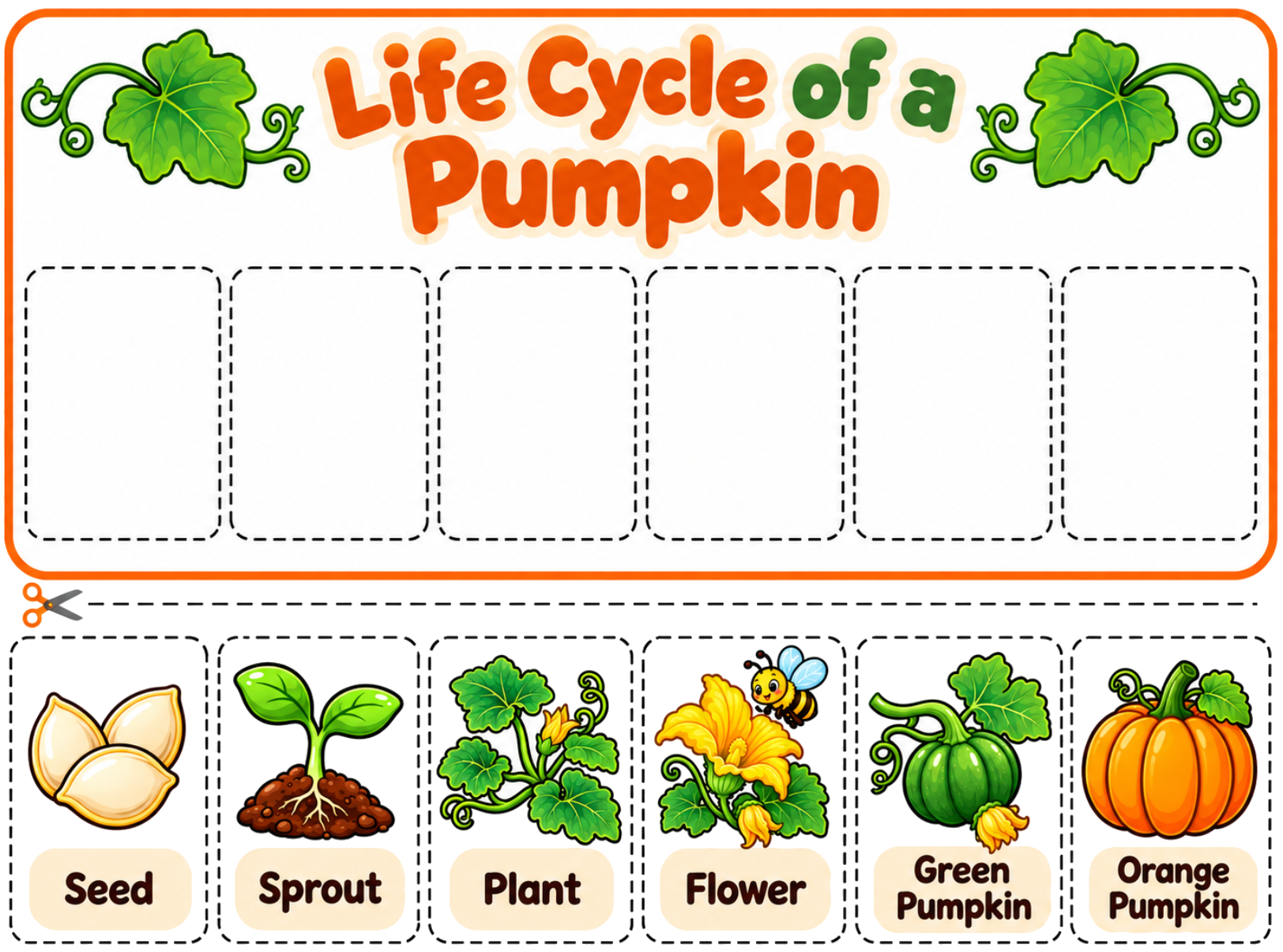
Some children go on to build an accordion-fold life cycle, gluing the stages in order and folding the mat back and forth. A check-your-work reference lets them correct themselves without waiting for me.
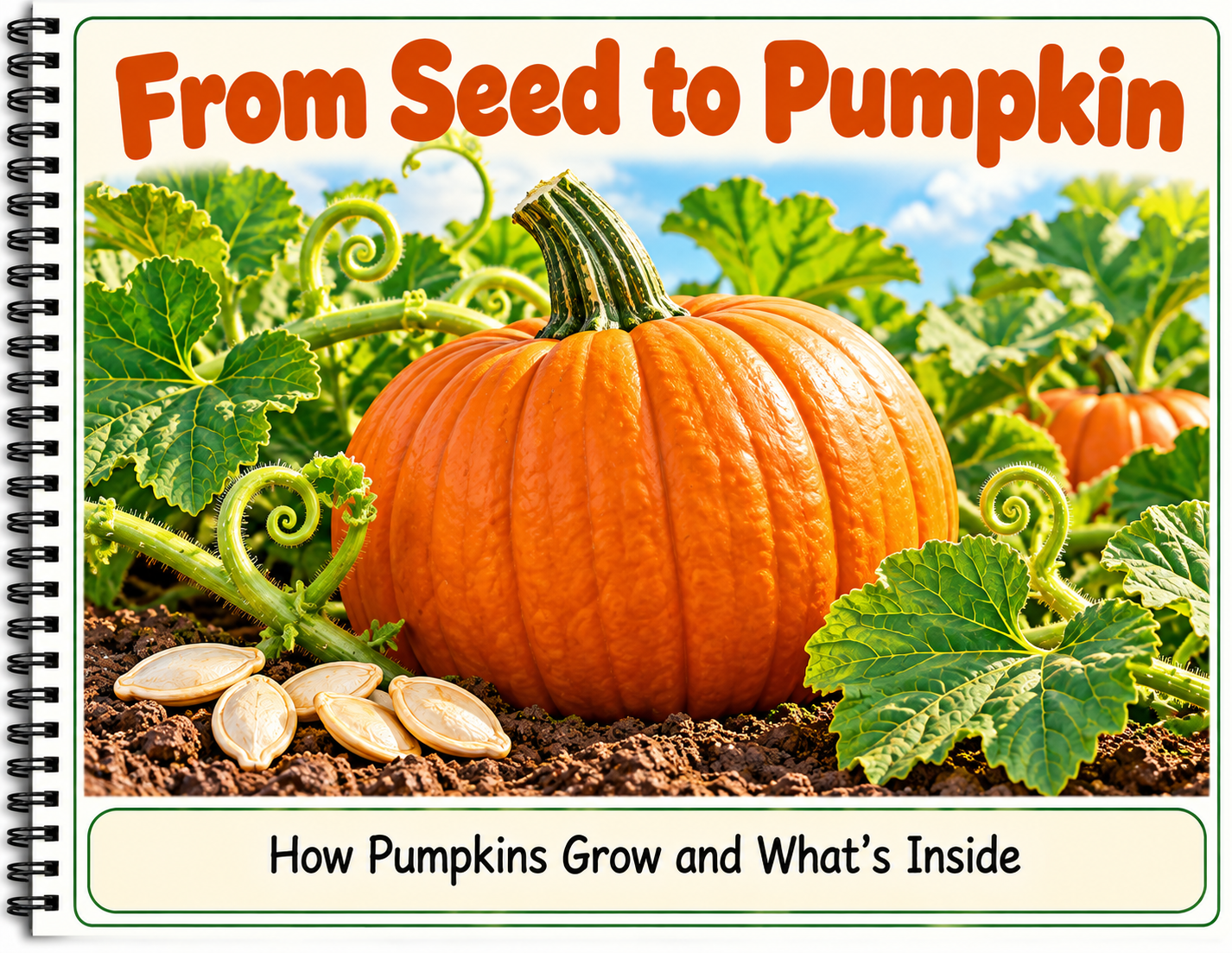
Not every part of a pumpkin investigation happens at the science table.
The read-aloud - From Seed to Pumpkin - ties it together. Before we begin, the teacher asks what a pumpkin needs to grow. During the story, we pause at the sprout, the flower, and the cutaway illustration to predict and observe rather than recite. Afterward, we go back to the real pumpkin and ask, “Where do the seeds come from?” The seeds inside the pumpkin are where the next life cycle begins.
We've also created an interactive version of the From Seed to Pumpkin read-aloud.
Instead of working through the entire story every time, teachers can choose to explore the complete book, jump directly to the pumpkin life cycle or parts of a pumpkin, or select an individual page for discussion.
That flexibility matters. If a child raises a question about how pumpkins grow, we can return to the flower or green pumpkin illustration without starting the story over.
The digital book includes recorded narration, and choice of auto or manual read, but I think its greatest value is as a shared teaching resource. Sometimes we listen to the story. Other times, we pause on a single illustration and simply talk about what we see.
Try the Interactive Storybook
Want to explore how pumpkins grow with your class?
You can open our interactive From Seed to Pumpkin storybook right here on Bridge Early Learning.
Listen to the complete narrated story, jump directly to the six stages of the pumpkin life cycle, or explore the parts of a pumpkin. You can also select individual pages for classroom discussions.
The storybook works on a computer, classroom projector, or interactive whiteboard.
Open the free From Seed to Pumpkin Interactive Storybook
The complete From Seed to Pumpkin unit also includes a downloadable version of the storybook for offline use, printable read-aloud pages, hands-on science investigations, math and literacy centers, and classroom posters.
The Same Pumpkins, Now in Math
The pumpkin patch becomes a place to explore numbers, too.
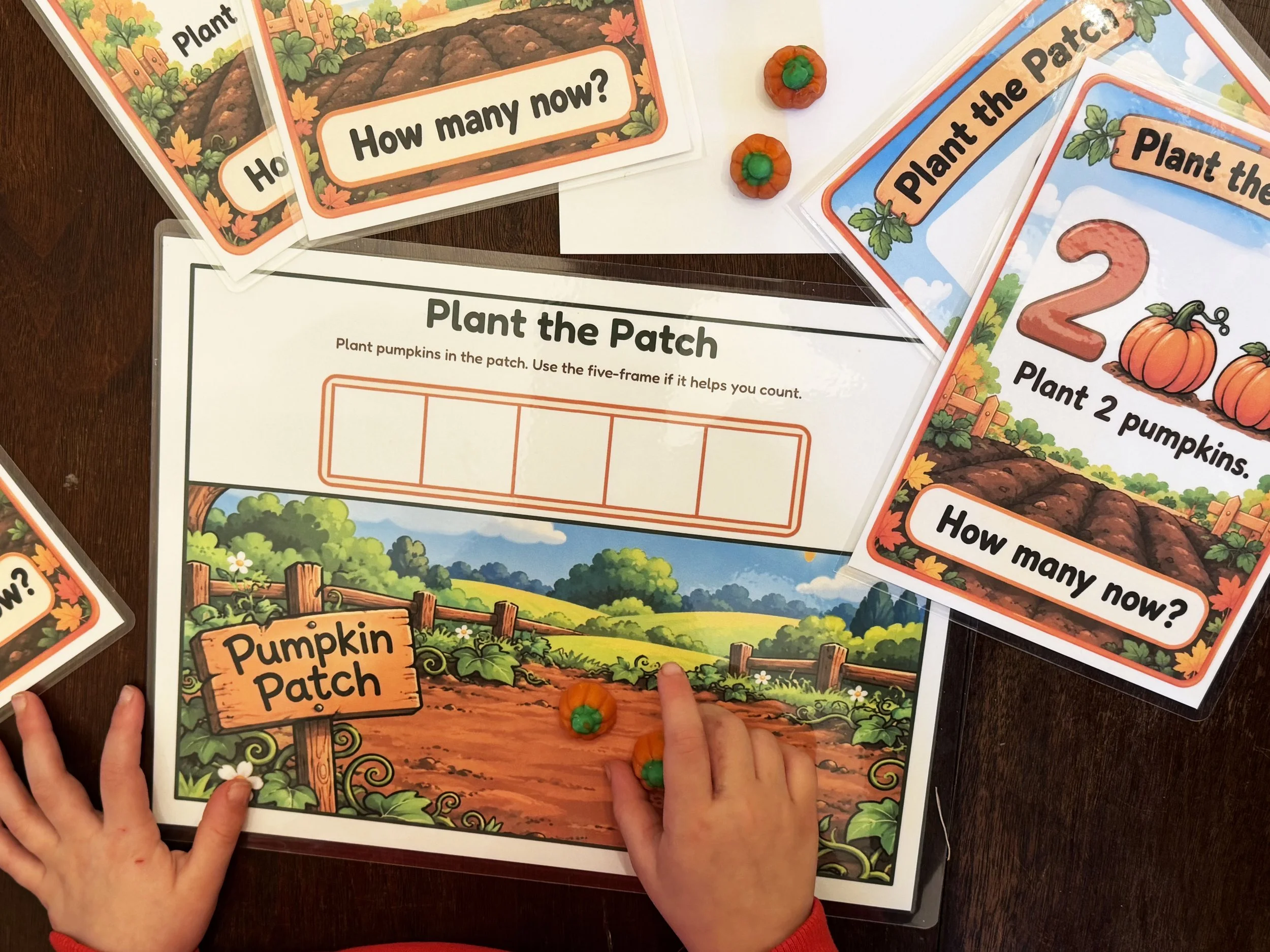
In our Plant the Patch activity, children choose a task card and plant miniature pumpkins in the patch. A five-frame provides a familiar structure for organizing and counting their pumpkins.
We created two sets of task cards. One shows a numeral alongside the matching number of pumpkins, giving children a visual model. The other shows only the numeral, inviting children to construct the set independently.
The difference became clear when we tried the activity with a three-year-old. She could recognize numerals through five but wasn't yet able to independently build the corresponding sets. The picture-supported cards gave her a visual reference, allowing her to match the pumpkins on the card with the pumpkins she placed in the patch. It was a useful reminder that recognizing a numeral and understanding the quantity it represents are different skills. The visual support helped her participate successfully while continuing to develop that connection.
As children become more confident building sets, the same materials introduce addition and subtraction. They plant more pumpkins in the patch or pick some pumpkins and move them to a basket.
Throughout the activity, simple questions encourage children to think about quantity: “How many pumpkins did you plant?” “How do you know?” and “What happened when you added one more?”
The materials remain familiar, but the mathematical thinking grows.
Words children can see
The literacy work grows out of the investigation, so the words already mean something. Picture-word cards name the pumpkin parts and the life cycle stages. Only a few are introduced at a time and our classroom keeps the two groups separate so children can see how the words relate.
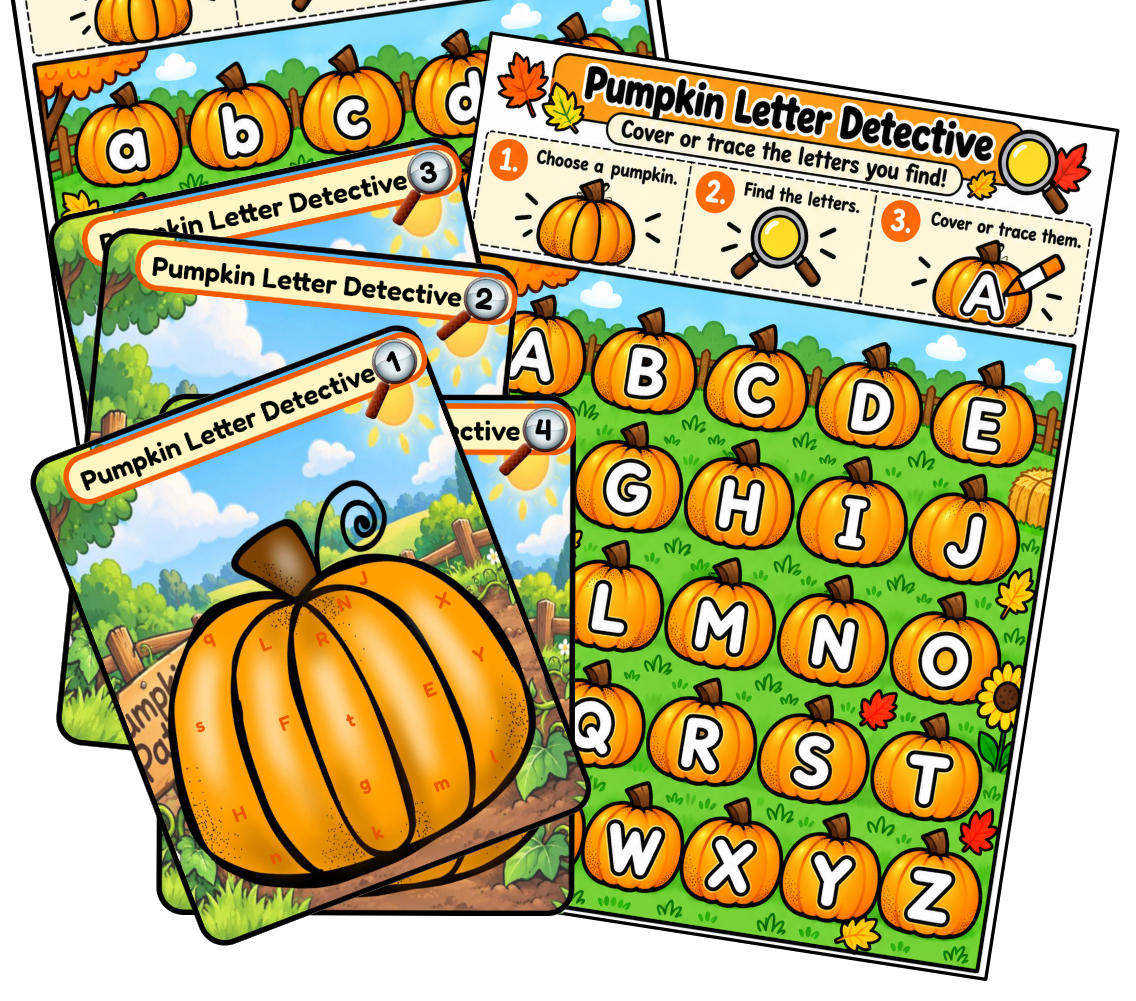
For letters, our “Letter Detectives” hunt for chosen letters on pumpkin-themed search sheets. The letters can all be seen without aid, but a magnifying glass makes a fun prop. (It’s more theater than tool, but nobody has complained.)
At a separate center, children trace and form uppercase and lowercase letters on pumpkin-patch mats, which we laminate for dry-erase markers or arranged manipulatives.
A few practical notes
An adult should always do the cutting and prepare the pumpkin sections ahead of time, putting them in trays. Not every child wants to touch wet, sticky strands, and that’s fine. Gloves, scoops, and observation-only participation all count as science. And, pumpkin pieces are for investigating, not snacking.
Why it works
What makes this investigation especially useful is that children can approach the same pumpkin in very different ways. One child cares about the slimy strands, another counts seeds, another wants to sequence the life cycle for the third time, and another is hunting for the letter S. All of them are building vocabulary, observing, and explaining.
This October, before the pumpkin becomes a jack-o’-lantern, give it a week as a science investigation. You may find that your youngest scientists have more to say about it than you expect.
Bring the Investigation to Your Classroom
Want to try a little pumpkin science with your preschoolers?
Start with our free Life Cycle of a Pumpkin labeling activities, designed for classroom demonstrations, science-table exploration, or individual practice.
Get the Free Life Cycle of a Pumpkin Labeling Activity
If you're ready to explore further, our complete From Seed to Pumpkin unit includes hands-on science investigations, life cycle activities, pumpkin patch math, literacy resources, two printable classroom posters, and an interactive narrated storybook.
Find the entire From Seed to Pumpkin Science, Math, and Literacy unit on TPT
Every Classroom Matters
We know that teachers often purchase classroom materials with their own money, and budgets aren't always able to stretch to everything they'd like to provide.
If this resource would be helpful in your classroom but the cost is a barrier, please email rick@bridgeearlylearning.com. We'll be happy to arrange a complimentary copy.
No explanation necessary. We simply want good resources to reach the children who can benefit from them.