There’s More Learning in the Doctor’s Office Than Meets the Eye
Giving dramatic play more purpose without turning it into a lesson
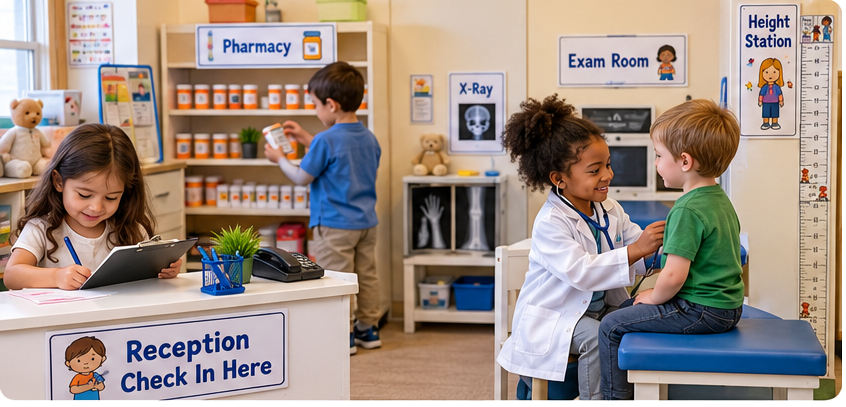
A doctor’s office is one of those dramatic-play themes that almost builds itself.
Add a toy stethoscope, a few bandages, a white coat and a clipboard, and children know what to do. Someone becomes the doctor.
Someone becomes the patient. Before long, somebody has a mysterious ailment requiring seventeen Band-Aids. And there is absolutely nothing wrong with that kind of play.
But as we built our Children’s Medical Center, we started wondering what would happen if we gave children a little more to work with.
Not necessarily more stuff. More purpose.
What if the receptionist actually had someone to check in?
What if the pharmacist had to figure out which medicine belonged to which patient?
What if the nurse could measure patients and compare their heights?
What if the eye doctor or X-ray technician had a problem to solve?
That became the idea behind the center:
Give children a role, then give that role something meaningful to do.
Once we started thinking that way, early math, literacy, language, measurement, visual discrimination, sequencing and problem solving began appearing all through the medical center.
And the children could encounter all of it while still playing.
A Role Is Good. A Job Is Better.
Putting on a doctor's coat gives a child a role.
Giving that doctor a patient chart and something to investigate gives the role a job.
The same applies throughout the center. The receptionist checks in a patient. The nurse measures someone. The pharmacist fills a prescription. The eye doctor conducts an exam. The X-ray technician decides which image belongs with the patient's pretend injury.
The materials were designed to give children reasons to communicate, match, count, measure, observe, record, decide and explain within the play itself.
That's quite a bit of learning hiding underneath a plastic stethoscope.
The Pharmacy Is an Early-Math Center in Disguise
The pharmacy may be our favorite example.
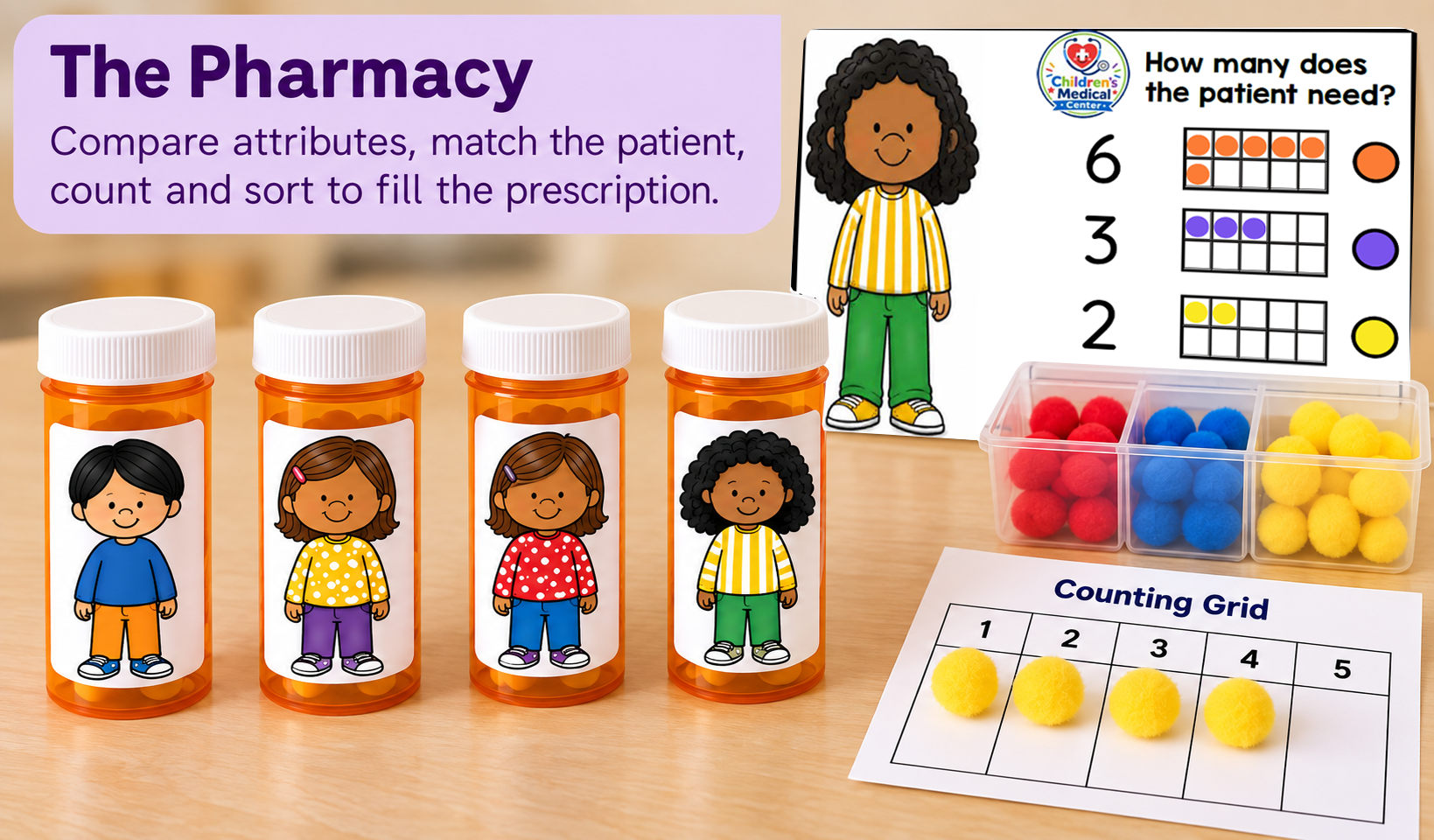
A child chooses a prescription card showing a particular patient and then finds that patient's medicine bottle. But simply matching the child's face would make the problem pretty easy.
So the same children appear in different clothing combinations.
Two bottles might show the same child wearing green pants and a yellow shirt. But one yellow shirt has vertical stripes while the other has dots.
Which one matches the prescription?
Now the pharmacist has to compare several attributes, notice what's the same and what's different, and make a decision.
That's early mathematical thinking, but the child isn't completing a “compare by attributes” exercise.
The pharmacist is finding the right patient's medicine.
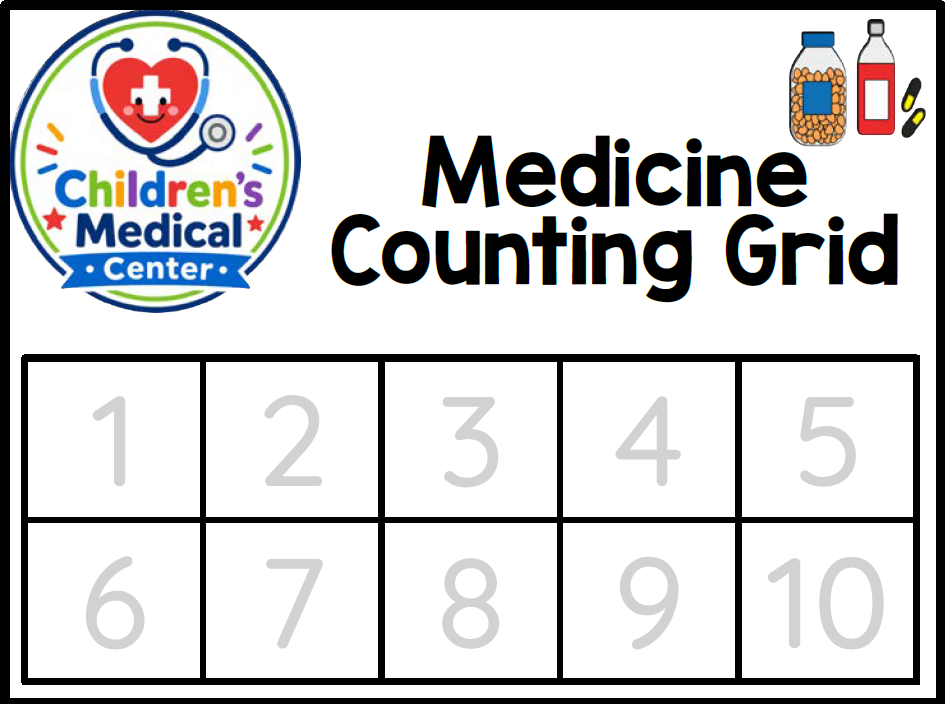
Then another layer begins. The prescription shows the colors and quantities of pretend medicine needed, using both numerals and ten-frames. Children sort by color, count the correct quantity and can use a counting grid to check their work.
One pretend prescription can therefore involve:
compare → match → recognize → count → sort → check
The mathematics has a reason to be there because the play created a problem that needed solving.
The Measurement Station Gives Numbers Meaning
A routine check-up also gives children a natural reason to explore measurement long before formal ruler work begins.
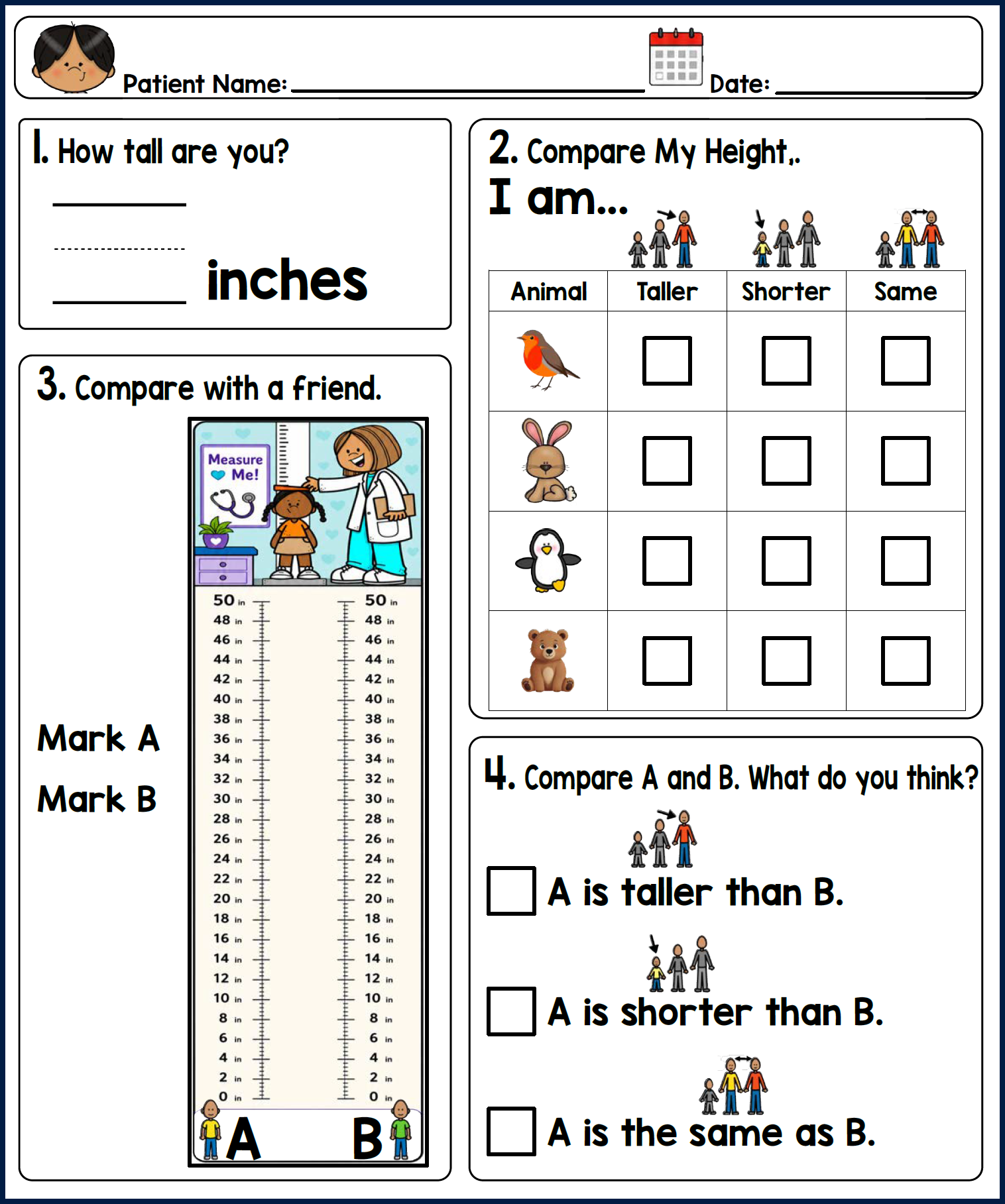
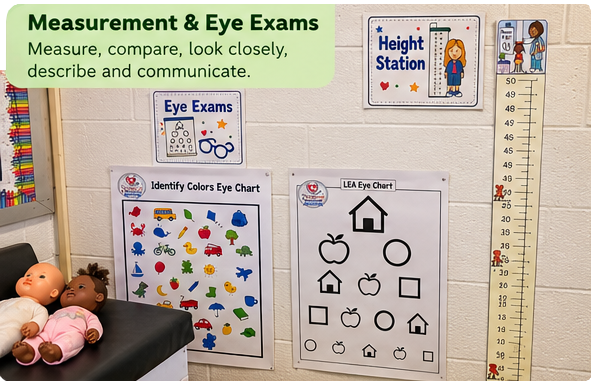
At the Height & Measurement Station, the nurse can measure a doll, stuffed animal or classmate against a vertical height scale and record the result on the patient's chart.
But the more interesting learning begins when there is more than one patient.
Who is taller?
Who is shorter?
Are two patients the same height? Where should each patient's marker go on the scale?
Am I as tall as a penguin, but shorter than a bear?
Four animal heights are embedded in the height scale to provide comparative referents even if only one child is measured.
Instead of encountering those words as isolated math vocabulary, children can use them to describe something they have actually measured.
The station can also introduce an important idea about measurement itself: everyone begins at the same baseline, and the scale gives us a consistent way to compare results.
There's no need to turn it into a formal measurement lesson. The nurse simply has a job to do:
measure → record → compare → describe
And suddenly taller, shorter and same height are useful words rather than vocabulary to memorize.
An Eye Exam Can Be About Much More Than Eyes
The eye-exam area follows the same principle.
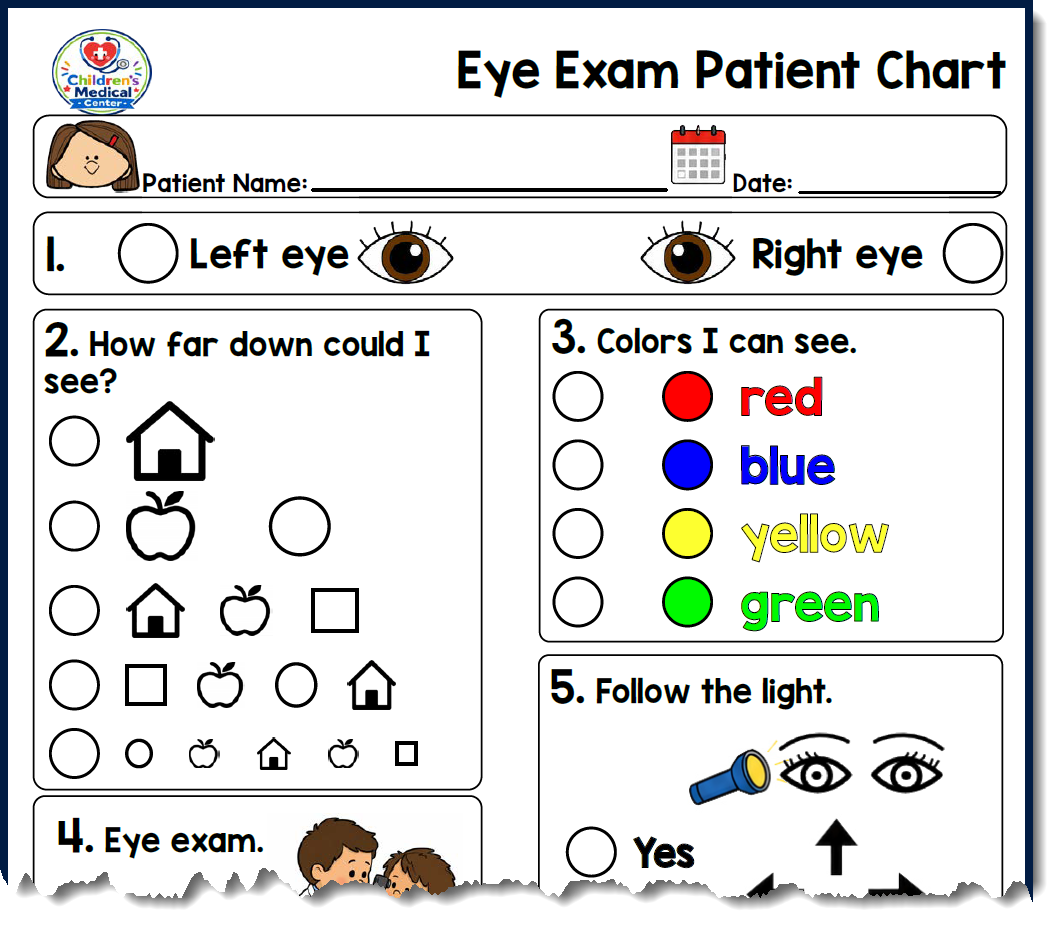
A symbol chart invites children to look carefully and match familiar shapes. A directional chart introduces up, down, left and right. A visual-search chart asks patients to locate objects by color.
Then the doctor can make the questions more interesting.
Can you find something yellow?
becomes:
Can you find something yellow you can ride in?
Or:
Can you find a green animal?
Can you find three blue things?
Now children are scanning, categorizing, combining attributes, counting and using language to explain what they see.
The eye-exam materials incorporate visual discrimination, matching, spatial vocabulary, counting, comparison and receptive and expressive language.
But to the children, they're giving an eye exam.
Give the X-Ray Technician a Problem to Solve
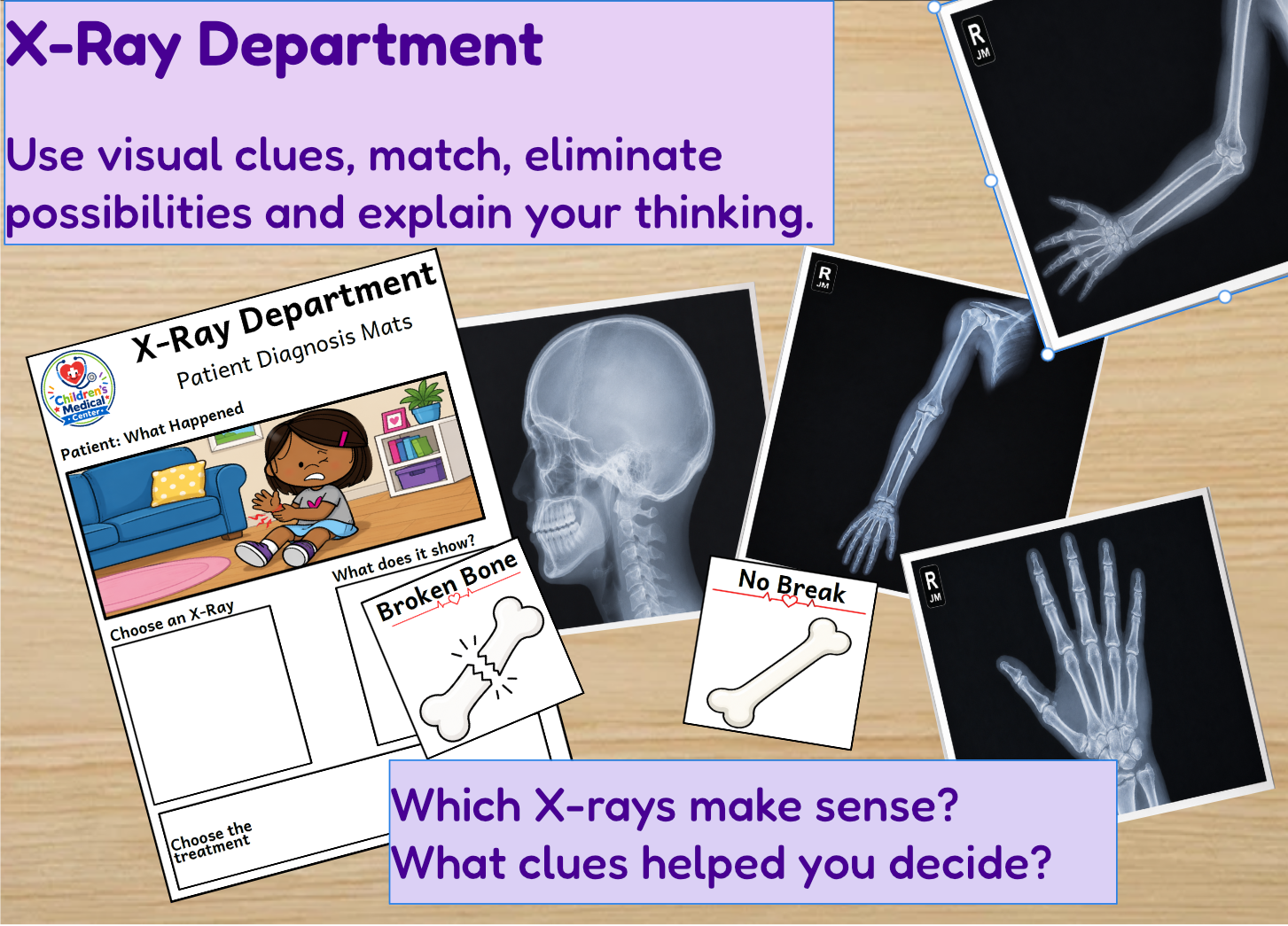
Children can certainly hold up a pretend X-ray and examine it. But give the patient a story and something changes.
The patient fell and hurt an arm.
Which X-ray should we use?
Is this an arm, a leg, a hand or a skull? Where would this X-ray belong on your own body? Which pictures can we rule out? What clue helped you decide?
The goal isn't to teach children to interpret medical images. It's to give them opportunities to observe, match, infer, eliminate possibilities and explain their thinking.
The pretend medical problem gives all that thinking a purpose.
Even the Signs and Labels Are Working
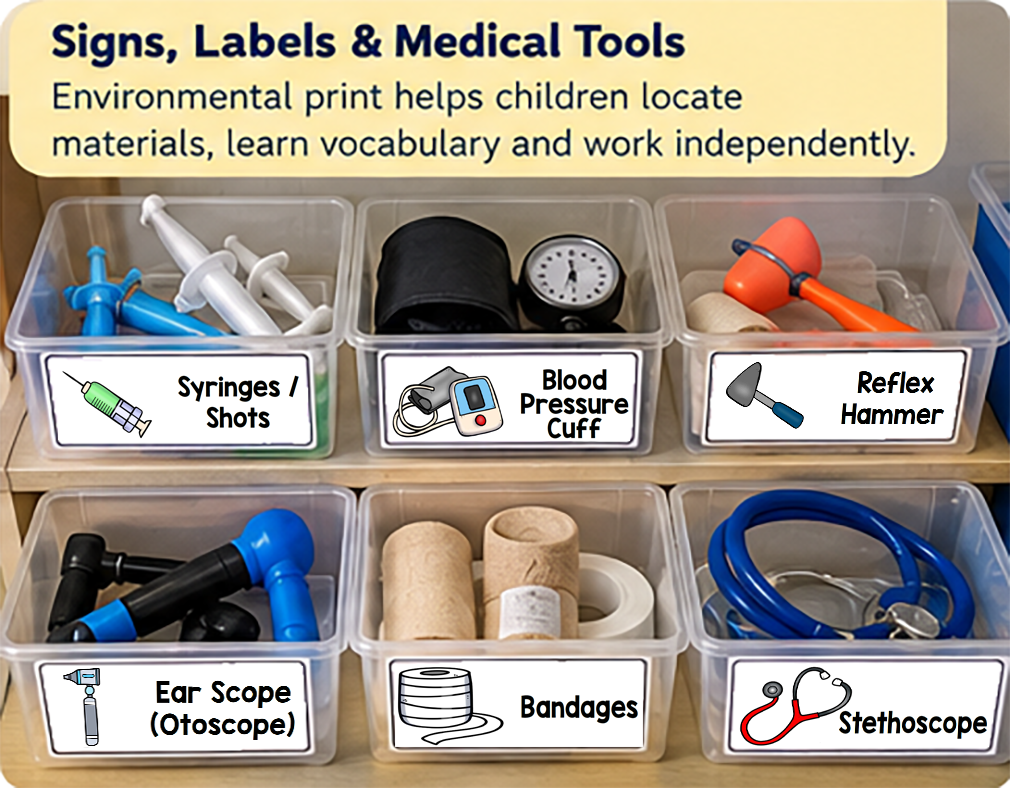
The print around the center has a job, too.
Reception. Waiting Room. Exam Room. Pharmacy. X-Ray.
Those signs don't simply decorate the space. They tell children where things happen.
Picture-word labels help children locate materials and put them away. Forms, charts and clipboards demonstrate another important idea: adults use print to communicate and record information.
Children don't need to be conventional readers for any of this to matter.
They're discovering that print carries information and helps us do things.
Start Small and Let the Center Grow
There is an obvious danger in all of this.
It's entirely possible to create a spectacular medical center containing so many signs, forms, activities and instructions that no four-year-old knows what to do with any of it.
So don't.
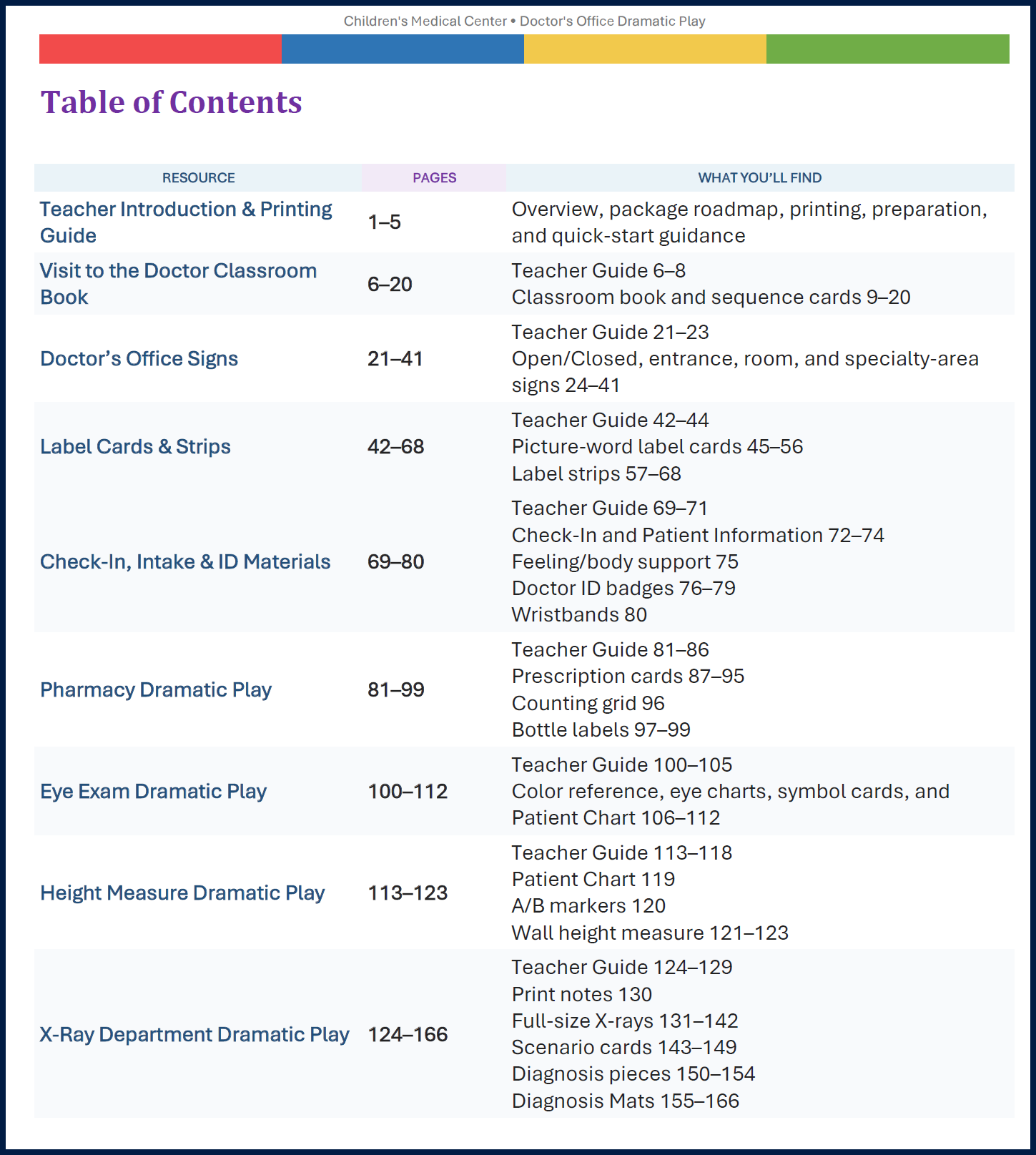
The collection was intentionally designed as a modular system rather than something that needs to be printed and introduced all at once.
Begin with a doctor's office children can understand. Add a few useful signs, tools and check-in materials.
Then let them play.
Later, perhaps the pharmacy opens. Another week, an eye-exam station appears. Eventually someone needs an X-ray, or the nurse starts measuring patients. The center grows as the children's play grows.
Follow the Play
There is one important line we try not to cross.
If every pharmacist is required to match three patients, fill four prescriptions and demonstrate one-to-one correspondence before moving to another center, we've probably lost the plot.
We've created a worksheet wearing a lab coat.
One child may spend most of the time matching prescription bottles. Another may measure every stuffed animal in the classroom. Someone else may conduct eye exams on anyone willing to sit still.
That's okay.
The materials create possibilities for learning inside the play. They don't need to dictate the play.
Meanwhile, the teacher gets some wonderful opportunities to observe.
Does the child compare more than one attribute?
Count with one-to-one correspondence?
Use a numeral or ten-frame to determine quantity?
Compare two measurements? Follow a sequence?
Explain how a decision was made?
Negotiate roles with another child?
Those little moments tell us a great deal.
Purposeful Play Doesn't Have to Look Like a Lesson
That's probably the biggest idea we've taken from building the Children's Medical Center.
We don't have to choose between play and learning.
Sometimes we simply need to ask:
What can we put into the play that gives children an interesting reason to use what they're learning?
The pharmacist needs to find the right patient.
The nurse needs to determine who is taller.
The receptionist needs to know who's checking in.
The eye doctor needs to communicate directions.
The X-ray technician needs to figure out which picture belongs with the patient's pretend injury.
The children have problems to solve because their characters have problems to solve.
And that may be one of the nicest places for learning to happen.