When a Child Can Say Every Sound but Still Can’t Read the Word
Helping beginning readers make the jump from separate sounds to blending
Sometimes a child looks at map and gives you exactly what you’ve been teaching:
/m/ … /ă/ … /p/
Every sound is correct.
Then you ask, “What word?”
Silence.
Or mat. Or man. Or a hopeful guess at something else entirely.
It can be a puzzling moment because the child appears to have all the pieces. The letters are recognized. The sounds are correct. They are even being produced in the right order.
But three correctly identified sounds aren't quite the same thing as reading a word.
The next job is learning how to pull those sounds together.
First, Make Sure Blending Really Is the Problem
Before giving a child more blending practice, it helps to know what is actually getting in the way.
Can the child identify the sound represented by each letter? Does the child consistently confuse short vowels? Are extra vowel sounds being added to consonants, so that /m/ becomes “muh”? Does the child lose or change one of the sounds while trying to blend? Or are all three sounds accurate, but the child simply can't combine them into a recognizable word?
Those differences matter.
If a child sees map but doesn't know the sound for m, more blending practice isn't going to solve the underlying problem. If the child says /m/ /ă/ /p/ accurately but can't produce map, however, we have learned something much more specific about what to work on next.
That is one reason we like looking separately at the pieces of early CVC reading rather than simply recording whether a word was read correctly or incorrectly.
If you're trying to determine where a child's CVC reading is breaking down, our companion article, When a Child Can't Read “map”, looks more closely at assessment and distinguishing among different kinds of difficulty.
Three Sounds Have to Become One Word
When we ask a beginning reader to sound out a word, we're actually asking for two related but different actions.
First:
/m/ /ă/ /p/
The child attends to the letters individually and connects each grapheme with its sound.
Then:
/mmmăăăp/ → map
Those separate pieces have to be pulled together and recognized as a word.
For some children, that second transition happens fairly readily. For others, the sounds seem to remain three separate objects. They can tell you each one beautifully, but when asked what the sounds make together, the pieces don't quite snap into place.
Simply asking the child to “blend it” again may not provide much additional information about how to do it.
Sometimes it helps to make an invisible process a little more visible.
Make the Change From Separate to Continuous Visible
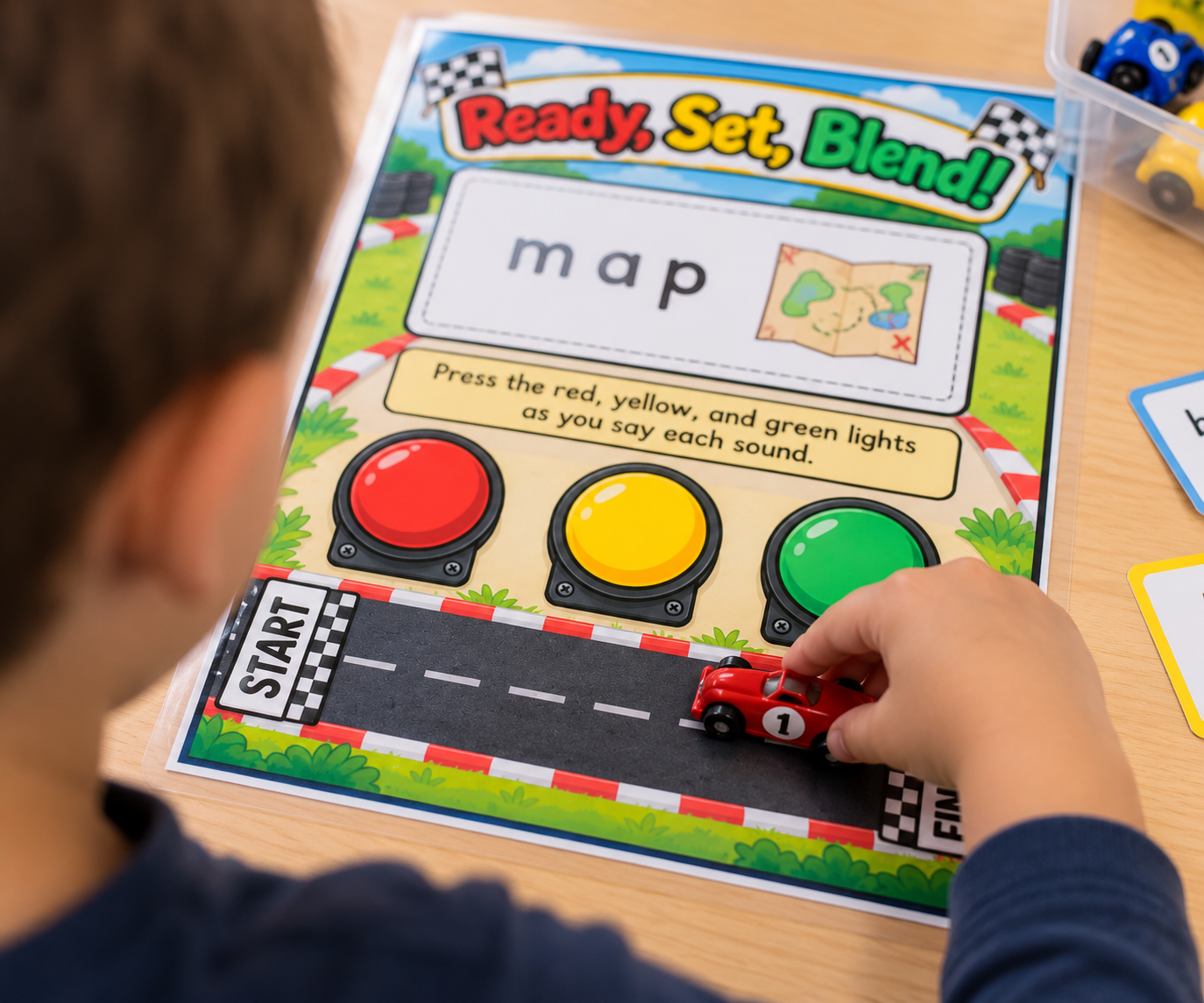
That's the idea behind Ready, Set, Blend!
The routine begins with three colored lights. The child touches the red, yellow, and green lights from left to right while saying one sound for each letter.
For fan:
/f/ /ă/ /n/
At this point, we want the sounds to be distinct. The child is attending to each grapheme and producing its corresponding sound.
Then the action changes.
Instead of touching three separate points, the child places a small race car at START and moves it smoothly across a track toward FINISH while blending the sounds together:
/fffăăăn/
At FINISH, the child says the complete word naturally:
fan
So the physical movement mirrors the change we're asking the child to make: Touch it → Say it → Drive it → Read it
The lights make the individual sounds visible. The racetrack turns three separate actions into one continuous action. Ready_Set_Blend_FULL
The race car isn't the important part. The change in the movement is.
Watch Those Little “Uhs”
There's another small detail that can make a surprisingly large difference.
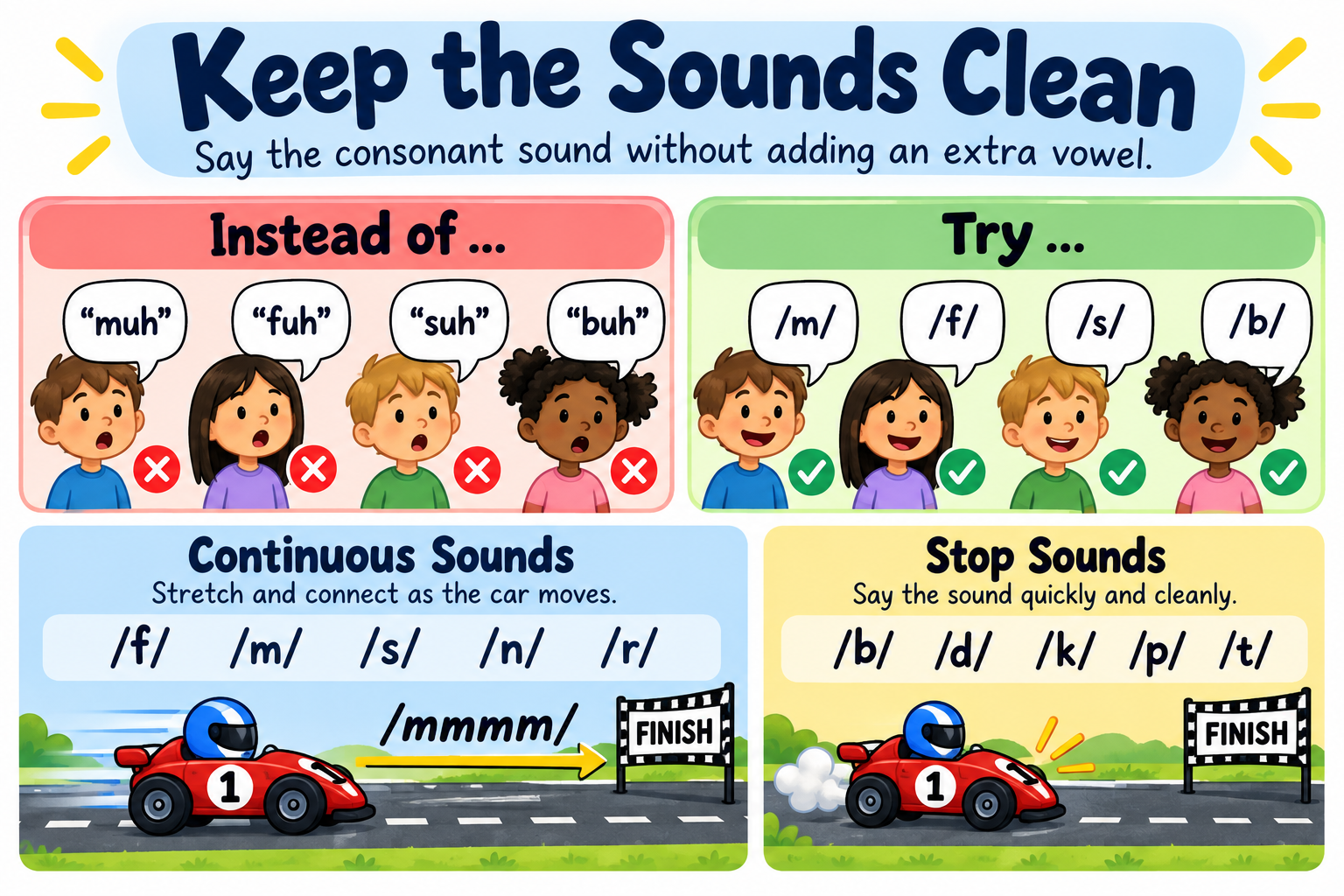
When modeling consonant sounds, try to produce the sound cleanly rather than attaching an extra vowel to it.
For example, we want:
/m/
rather than:
“muh”
and:
/f/
rather than:
“fuh.”
Those little added vowels can make blending harder because the child is now trying to combine sounds that aren't actually in the word. The Ready, Set, Blend routine specifically calls for clean consonant production and distinguishes between sounds that can be stretched and stop sounds that should remain crisp.
With continuous sounds such as /f/, /m/, /s/, /n/, and /r/, we can stretch the sound as the car moves.
Stop sounds such as /b/, /d/, /k/, /p/, and /t/ work differently. We don't want to turn /b/ into “buhhhhh” just because our race car has a long track ahead of it.
The car may enjoy the scenic route. The phoneme doesn't need one.
Start With Words the Child Is Ready to Read
A blending activity isn't the best place to introduce six unfamiliar letter-sound correspondences at the same time.
If blending is what we're trying to practice, choose words made from sounds the child already knows.
Three to five carefully chosen words may be plenty at first.
You might stay within one short-vowel family or choose a small collection containing familiar consonants. Once the child becomes more successful, mix short vowels, introduce more consonants, and gradually increase the variety. That's also how the Ready, Set, Blend teacher guide recommends selecting from the larger set of word cards.
That helps us keep the instructional question clean:
Can the child blend these known sounds together?
rather than:
Can the child remember the sounds and discriminate the vowel and blend the word all at once?
There will be time for that.
When It Doesn't Work the First Time
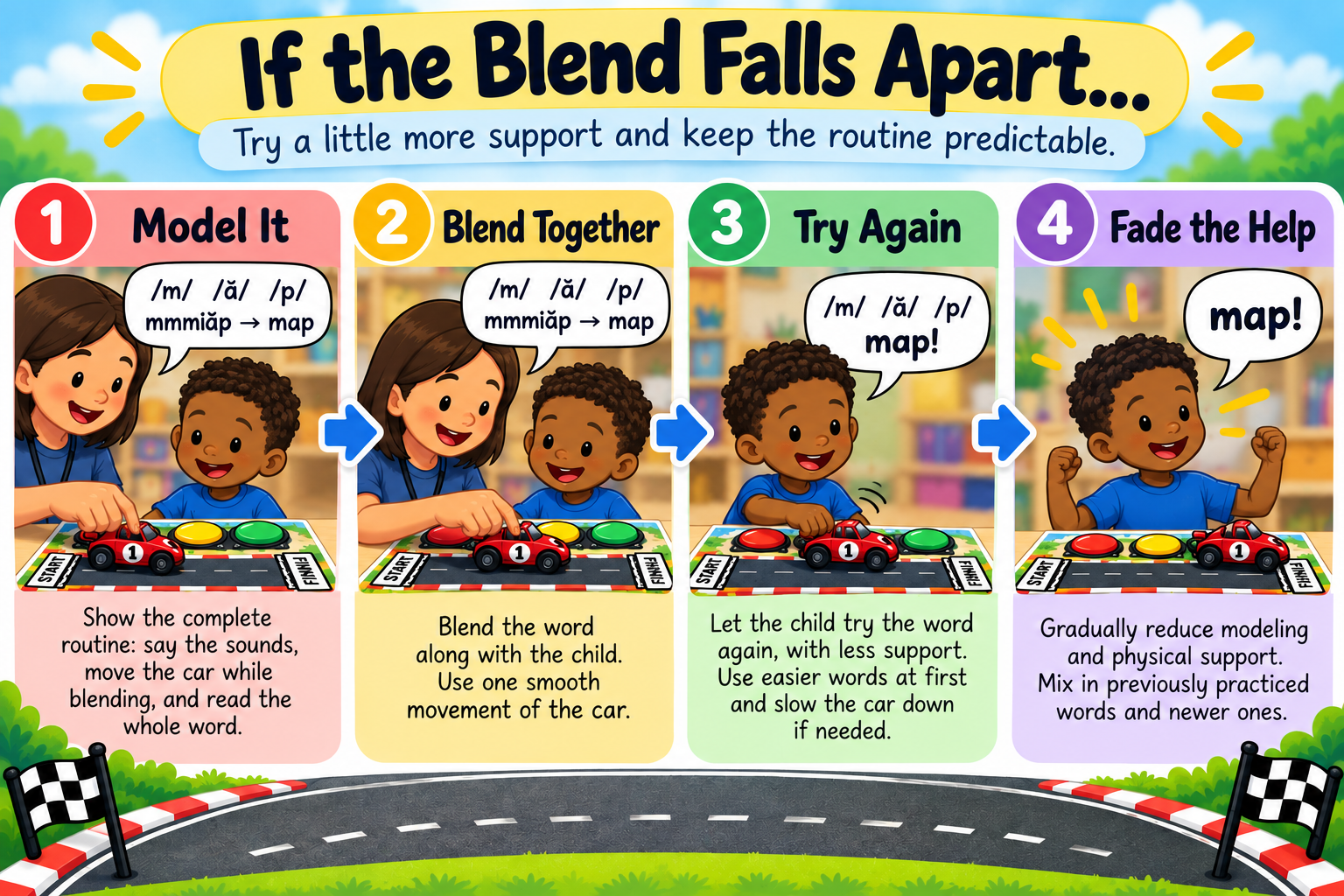
If the child produces the individual sounds correctly but the blend falls apart, don't necessarily change the whole activity.
Model it.
Blend alongside the child.
Slow the car down.
Use a word containing sounds that are easier to stretch and connect.
Then try the word again.
The routine itself can remain predictable while the amount of teacher support changes. The Ready, Set, Blend guide recommends modeling the complete blending motion, blending together when necessary, encouraging one smooth movement rather than three separate jumps, and gradually reducing support as the child becomes successful.
That predictability has value.
The word changes.
The thinking changes.
The routine doesn't have to.
Watch What the Child Does, Not Just Whether the Answer Is Right
This kind of practice also gives us another opportunity to observe.
Does the child immediately recognize each letter sound?
Does one short vowel consistently cause trouble?
Are the three sounds accurate until the child begins blending?
Does one sound disappear along the way?
Does the child look at the first letter and guess before attending to the rest of the word?
Does a single teacher model suddenly make the next attempt successful?
Those patterns can tell us considerably more than a stack of right and wrong answers. They may point toward additional work with letter-sound correspondence, phonemic awareness, short-vowel discrimination, or blending itself.
And that brings us right back to assessment.
We're not practicing CVC words simply to accumulate correctly read CVC words. We're watching children learn how the alphabetic system works and trying to notice what support will help them take the next step.
The Race Car Should Eventually Drive Away
There is one more important part of using a scaffold like this:
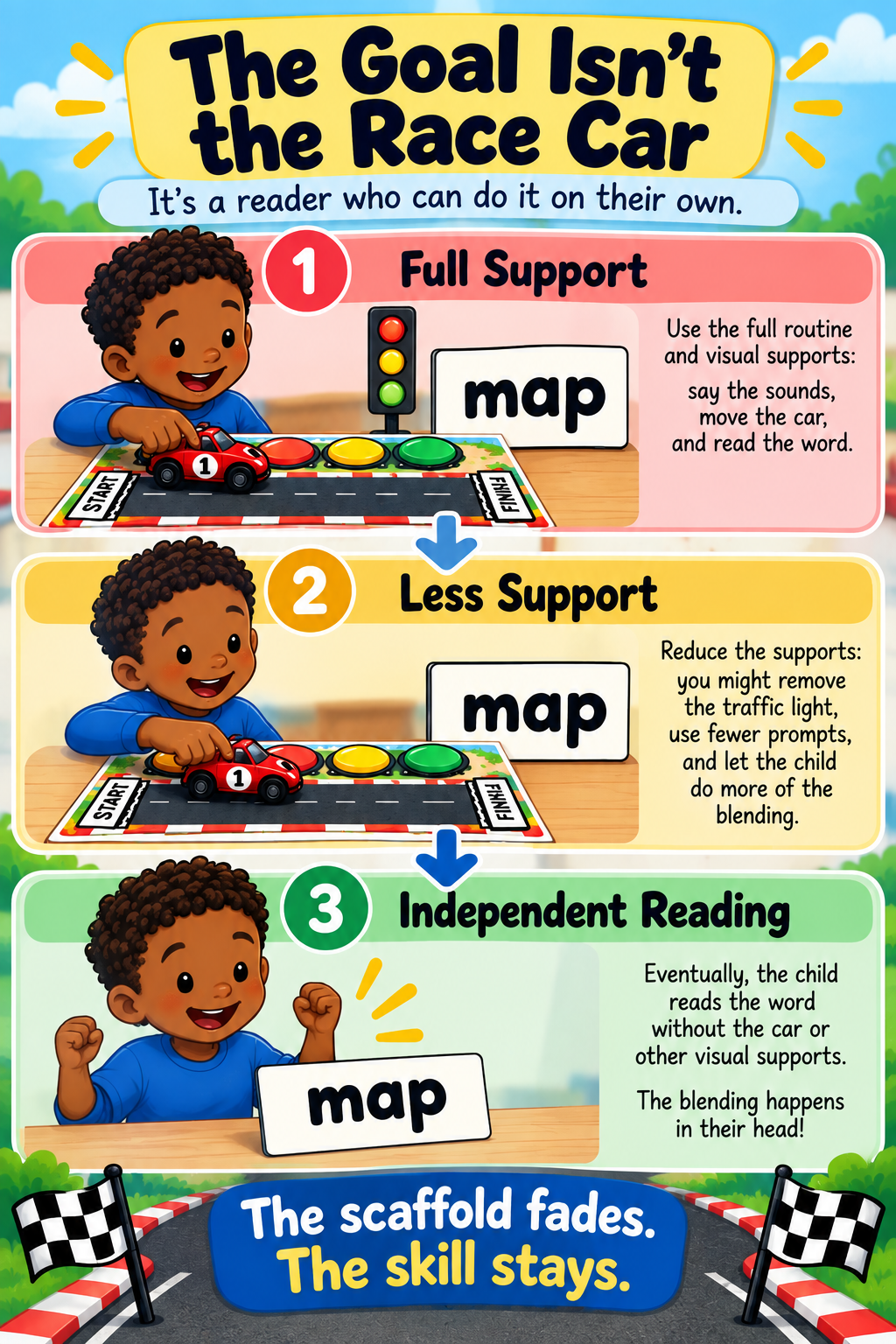
Eventually, we want to get rid of it.
The goal isn't for a child to believe that reading requires traffic lights and a tiny automobile.
Once blending becomes more successful, begin fading the physical support. Have the child blend a word with the car and then read it again without the car. Mix previously practiced words with newer ones. Reduce teacher modeling. Eventually, present the word and see whether the child can perform the process mentally.
The teacher guide puts it nicely: “The race car is a scaffold, not the destination.”
What we want left behind is the skill: See the letters. Connect them to sounds. Blend the sounds. Read the word.
No racetrack required.
Rick
Try Ready, Set, Blend! in Your Classroom
If you have a child who can say the individual sounds but still has trouble pulling them together into a word, Ready, Set, Blend! provides a simple, repeatable routine for practicing that transition. The complete resource includes the activity board, printable race cars, a teacher guide, and 226 CVC word cards in both color and black-and-white versions.
For now, we're making the complete Ready, Set, Blend! resource available free.
Use a few words. Watch what happens. Adjust the support. And when the child no longer needs the race car, let it retire to the parking lot.